In development for iPhone

You have a garage, one printer, and no money.

Spoolbound is a pixel-art tycoon about running a 3D-printing shop. Printers make parts, parts become products, products fill contracts, and the money buys better machines. You start with nothing and dig your way out.

Tell me when it’s out
The opening screen of Spoolbound: a small isometric garage with a single 3D printer on a trestle table, the floor covered in fourteen piles of junk, and a wallet reading zero dollars.
The first thing you see. Fourteen piles of junk, one machine, $0.

It is about printing, not about a factory that could be anything

Most tycoon games would work just as well if the widgets were shoes. This one would not. The machines are real archetypes — an open-frame bedslinger with the spool on a crossbar, an enclosed cube with a filter can on the roof — and the materials behave the way they behave on your desk. Tough copolyesters run happily in open air. Styrenics warp and sulk unless the chamber is hot.

None of it is named after anything you can buy, because the jokes are better that way.

  • HotboxAn enclosed machine that holds its own heat, so the fussy materials stop lifting off the plate.
  • Purge BlockThe little tower of wasted filament a machine prints beside the job to clear the old colour out.
  • Elephant’s FootThe squashed, bulging first layer you get when the plate is a shade too close or too hot.
  • BrimThe flat skirt printed around a part to stop the corners peeling up mid-job.
  • Z-HopLifting the nozzle before it travels, so it stops knocking over what it has already built.
  • OverhangThe angle past which a layer has nothing underneath it and starts to droop.

What it looks like while you play

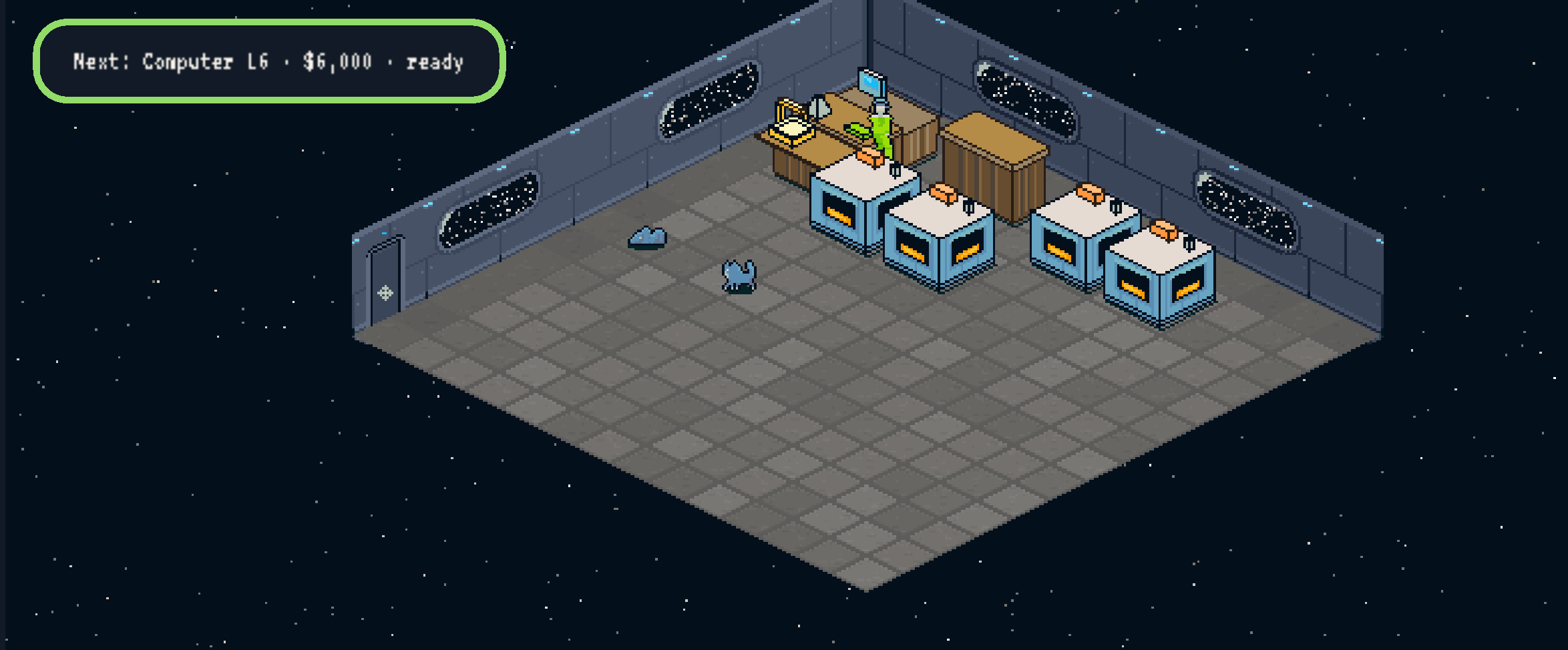
Every frame below is a shop that was actually earned — played forward from the same empty garage above, with no money granted and nothing unlocked for the camera. The art is placeholder geometry and the shots are honest about that.

  • The garage after eight minutes of play: two printers running on a bench, most of the junk cleared, the character clearing another tile for eighteen dollars.
    Eight minutes in. Clearing the floor by hand pays $18 a tile, and it is the only income you have.
  • The same garage later: four printers running across two benches, no junk left on the floor, $1,470 in the bank.
    Twenty-five minutes. Four machines on two benches, the floor finally clear.
  • A fuller garage: four open-frame printers on benches beside a larger enclosed machine, with research banked and a collect button showing parts ready.
    Just under an hour. The enclosed machine arrives, and with it the materials that need a hot chamber.

One promise, and it is permanent

“The offline timer is not for sale, and never will be.”

When your shop is working while you are away, there is no way to pay to make it hurry — not with money, not with a currency, not with anything. That is written into the game’s design documents as a rule rather than a preference, which is the only kind of promise worth making out loud.

From the devlog

All posts →

We write up what we build, including the measurements that said we were wrong.

You are employee number one

Not a foreman, not a builder slot waiting on a timer. You are the person doing the work, and your own time is the thing you run out of first. Everything you buy later is a way of buying that time back.

Spoolbound is being built for iPhone. It is not finished — you can follow how it is going in the devlog.